The final ten nights, what to do and what to postpone
Spend is at its peak, the window is ten days, and there's no time left to recover from a mistake. Two short lists: what's worth doing inside those ten days, and what waits until after Eid.
Everything you did in the first twenty days was preparation for these ten. Spend is at its annual maximum, the buying window is compressed into a few night hours, and there's no time left to recover from a mistake.
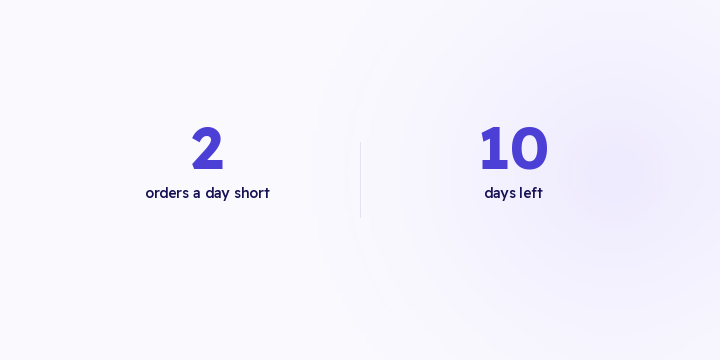
The target is 500 orders. You have 320 after twenty days, with ten days left.
Remaining: 180 orders over 10 days = 18 a day
Your current rate: 320 ÷ 20 = 16 a day
A gap of two orders a day. Trivial if you see it today, hard to make up if you see it on the last day of the month.
Channel mix, creative performance and product splits all carry too much noise at a ten-day scale. And usually they aren't something you can act on inside the window anyway.
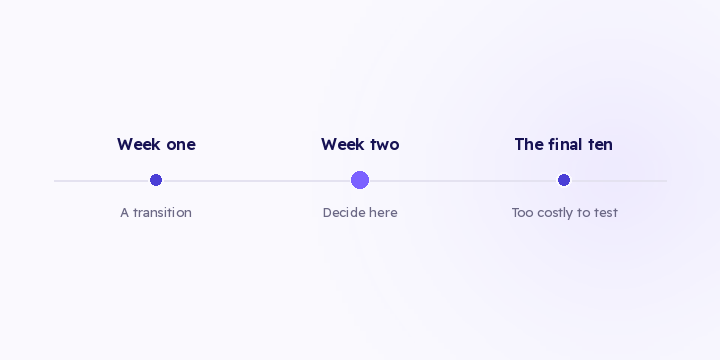
Reallocate on direction established earlier. The decision about which channel gets the final-ten budget should have been made in week two, on the slope rather than the level. See mid-Ramadan. Executing that decision now is fine, but don't try to build it from scratch inside these ten days.
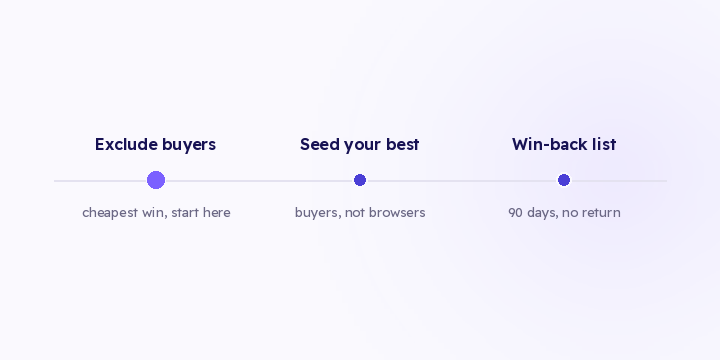
Exclude buyers from retargeting. Retargeting waste grows with volume, and volume is at its highest here. Every day a buyer stays in the audience, you pay peak-season prices to reach someone past the purchase. See audiences from your own data.
Check delivery twice a day. At peak spend, a break nobody notices costs more than at any other point in the year. See alerts that matter.
Watch pace once a day, in the evening. After the peak forms, not before it.
Don't launch a new campaign. It'll spend its learning phase across your most expensive ten days and convert after Eid at best.
Don't change tracking. A silent failure this week costs more than at any other point in the year, and no settings change is worth that risk now.
Don't change the attribution model. The season stops being comparable to any period, including next year's final ten.
Don't read reports at week level. At this scale a weekly average is mostly a description of a period that already ended.
Revenue by source, attribution trends, conversions delivered per destination and audience building are live in Flowfy today, and they cover reallocation, exclusion and the delivery check. Goal pace tracking with a computed daily rate is on the roadmap and hasn't shipped, so the calculation is two spreadsheet lines each evening.
If you reach day 25 far off the required rate, accept that the target won't be met and optimise on margin rather than volume. A deep discount taken in panic usually costs you more than it brings in, and it closes only a small part of the shortfall.
In this window, only raise budget on channels whose direction supports it. An across-the-board increase also funds the declining channel at peak prices.
Two things, in order. Don't judge the week after Eid against a normal week, because the rhythm returns gradually and the comparison will read as a collapse. And write down what broke and how long it took anyone to notice, because that figure applies again next year at higher spend, and nobody remembers it eleven months later.
And treat Eid as its own period with its own baseline, because mixing it into Ramadan costs you the read on both.
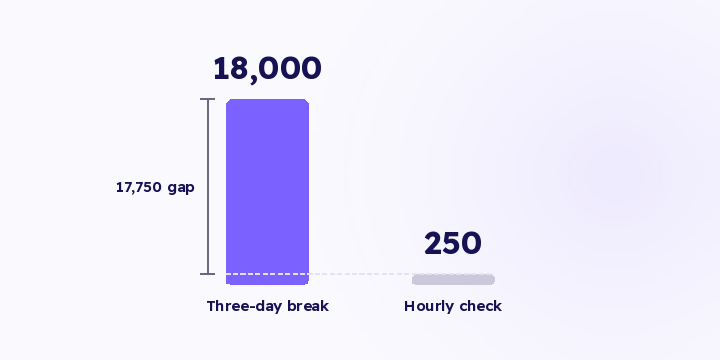
A three-day tracking break at peak spend exposes you to 18,000 SAR. An hourly check brings the same exposure down to about 250. The difference isn't the fix, it's how long you ran without seeing.
Week one is a transition and the final ten are too expensive to experiment in. That leaves week two, with stable data and enough season left for a decision to pay off.
A platform pixel only knows browsing inside that platform. Your store knows who bought, what they spent and which channel brought them. Here are three lists worth building, and how to keep them from going stale.