For many Saudi stores, influencer marketing is the second largest line after paid media, and it's the one measured most loosely. The measurement is usually a discount code, and a code answers a different question than the one you're paying for: who remembered to type it, not who was influenced.
You give each creator a code and count the orders that used it. Simple, and wrong in four directions at once:
Someone sees the content, visits two days later and forgets the code, so the order goes to another channel
The code leaks into deal groups, so people who never heard of the creator use it
A buyer who came from your own ad uses a code they found elsewhere, and the creator gets credited for your paid traffic
A creator without a code has no number at all
The result isn't too high or too low. It's mixed, which is the worst case: you can't correct a number when you don't know which direction it's wrong in.
You give every creator and affiliate their own link, and the order is credited to the link it actually came through, code or no code. Two properties make that work.
The source survives the gap. A visitor who arrives through the link, leaves, and comes back two days later by typing your store name is still credited to that creator, because the source is held for the length of the journey rather than the session. Flowfy uses a 90-day window.
The source is written server-side. At checkout it's attached to the order on the server, so an ad blocker or an expired cookie doesn't erase it.
That puts the creator in the same report as Meta, TikTok and Snapchat, under the same attribution model and the same window. You compare source against source with one ruler instead of judging a discount code against a paid campaign.
Each was paid 5,000 SAR, and each had their own link:
Visits
Orders
Cost per order
Creator A
900
45
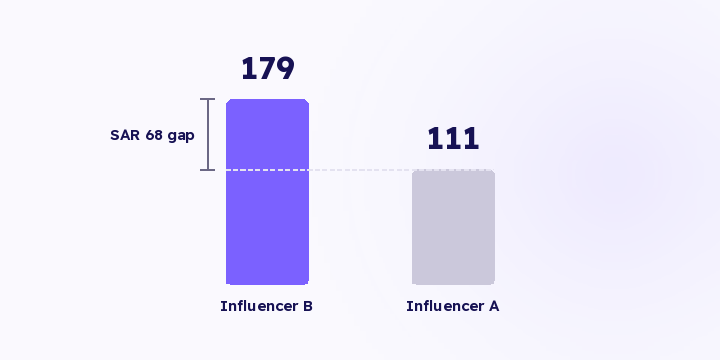
111 SAR
Creator B
4,200
28
179 SAR
Creator C
600
6
833 SAR
Illustrative figures.
Without links you'd have praised Creator B for sending more than four times the traffic. With the numbers, Creator A is 68 SAR cheaper on every order, and Creator C isn't worth renewing at that fee.
The negotiation changes too. Renewals get decided on orders and revenue rather than on follower count or on how the week felt.
Codes help conversion, so keep them as an offer for the audience. Then put two numbers side by side: orders from the link, and orders that used the code. The distance between them tells you how far the code travelled and who's using it.
If a creator posts without a link, in a story for example, you lose attribution for that placement. That's the case for requiring a tracked link in the brief before the collaboration starts. The same mechanic works for affiliates, where each link behaves as its own source inside the channel report.
Direct isn't a channel. It's the bucket for every visit you failed to name, and most of what sits in it is links you own: the bio link on Instagram and TikTok, a WhatsApp group, a QR code on packaging, the newsletter and SMS, a link you sent one customer in a chat.
Each of those takes about ten seconds to tag, and each becomes its own source instead of collapsing into direct. Measurement quality is decided before the click, not after it, because no analytics tool can put a name on a visit that arrived without one.
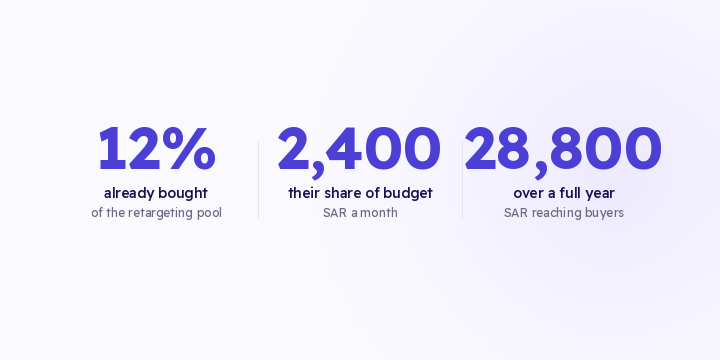
12% of a retargeting audience has already bought, and their share of the budget is 2,400 SAR a month. The waste never shows up as a loss anywhere, which is why it runs for years. Here's the arithmetic and the exclusions to run.
A blended repeat rate mixes a customer of three weeks with a customer of two years. Grouping people by when they arrived turns a static number into a curve you can act on. Here's the idea and three objections to it.
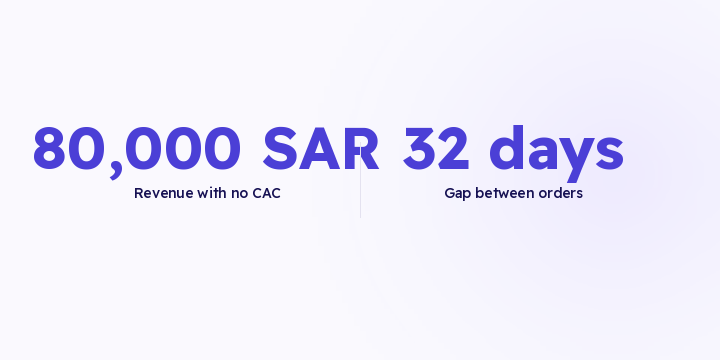
The second order has its own journey and its own channels, and it's the cheapest revenue you have. Here's the arithmetic, and the time gap that decides when to act.