

Attribution
How fourteen identifiers become one customer
A phone visit and a laptop purchase are two separate records. Here's what merges them, why backfilled history changes your attribution, and what moves in your numbers afterwards.
3 min read
Of all the audience work you could do this week, the highest return per hour involves no new targeting, no creative and no new budget: removing buyers from the audiences you're paying to reach.
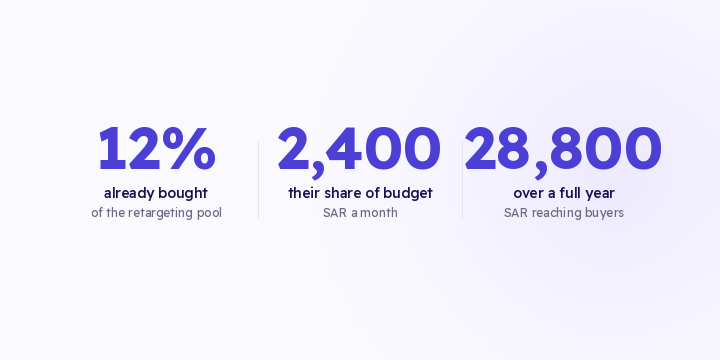
A retargeting budget of 20,000 SAR a month, running against an audience of 50,000 people. Say 6,000 of them bought during the month, which is 12%.
Their share of the budget is 20,000 × 12% = 2,400 SAR a month. Over a year that's 28,800 SAR spent reaching people you already have. (Illustrative figures.)
None of that shows up as a loss anywhere. It reads as ordinary spend on a campaign with a healthy return, and the return looks healthy partly because the campaign is being credited with orders from people who were coming back regardless.
You can get your own percentage in ten minutes. Take the size of the retargeting audience and compare it with the number of buyers over the same period the audience rule covers. Multiply the share you get by the retargeting budget, and that's how much spend is going to people who already bought.
It has no error state. Nothing breaks, nothing gets rejected, no number turns red on any dashboard, so there's nothing to prompt anyone to look.
It improves the metric it's judged by. Retargeting a buyer produces conversions, so the campaign's return rises. The waste itself makes the campaign look better than it is.
Nobody owns it. An exclusion isn't a campaign, a creative or a report, so it never enters a weekly review. It's a maintenance task with no clear owner, which is how it gets built once and never updated.
Building the list once is easy. The value leaks away in the updating, because membership changes daily while the list you uploaded stays frozen.
Export the audience, upload it, and forty-seven days later three things have happened in parallel:
Any manual step that repeats gets done once or twice and then quietly stops, especially when it has no fixed slot and nobody asks about it. That's how a store ends up running an exclusion list that was accurate last quarter.
Flowfy builds audiences from your customer data and exports the list. You set the rules, things like purchase window, value threshold, acquisition channel and order count, and it returns the member count before you save. Automatic daily sync to the ad platforms is on the roadmap and hasn't shipped. Until it does, the routine is a scheduled manual export. And because the export is a query rather than a saved snapshot, re-running it returns current membership rather than membership on the day you built the list, so updating is cheap as long as someone remembers.
| Exclude | From | Why |
|---|---|---|
| All buyers | Acquisition retargeting | You're paying to reach people past the purchase |
| Recent buyers | Prospecting campaigns | They aren't buying again this week |
| High-frequency non-buyers | Retargeting | They've seen your ads many times and haven't bought |
The third is the least obvious and worth running once. A segment that has seen your ads repeatedly without converting costs you frequency with nothing to show for it, and degrades the experience for everyone else in the auction.
Excluding people doesn't mean giving up on existing customers. If you want to sell to them again, put them in a separate retention campaign with its own budget, message and measurement. The difference is that you then know what you spend on acquisition and what you spend on retention, instead of mixing them into one campaign with an inflated return.
Order of work: start with the first, since it's the largest amount and the easiest to apply, then the second, and leave the third until the first two are on a fixed update schedule.
If one customer appears as three profiles, excluding one of them excludes a third of a person. An exclusion list quietly underperforms in proportion to how fragmented your identity data is. And the most fragmented profiles belong to your most active customers, who are precisely the ones you want excluded first. See identity resolution.
Set one day a week to refresh exclusion lists, and make it daily during a season when buyer volume peaks. Before you make the change, tell your team the reported return on retargeting will fall, because you've removed conversions it was being credited with, while the real return improves.
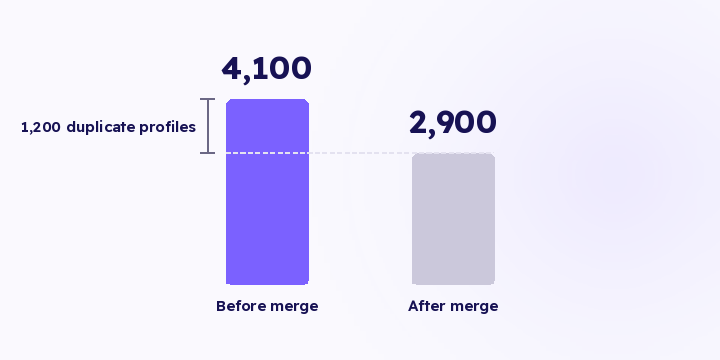
A phone visit and a laptop purchase are two separate records. Here's what merges them, why backfilled history changes your attribution, and what moves in your numbers afterwards.
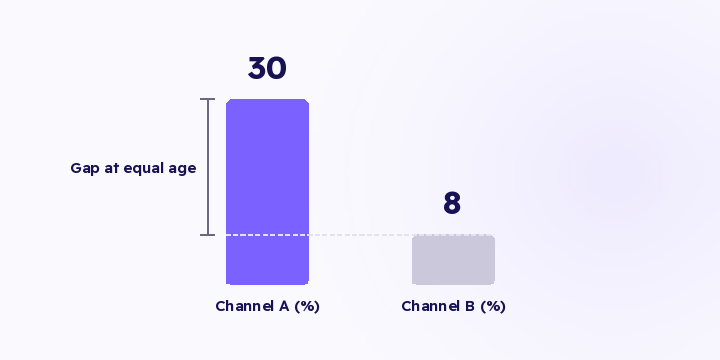
A blended repeat rate mixes a customer of three weeks with a customer of two years. Grouping people by when they arrived turns a static number into a curve you can act on. Here's the idea and three objections to it.
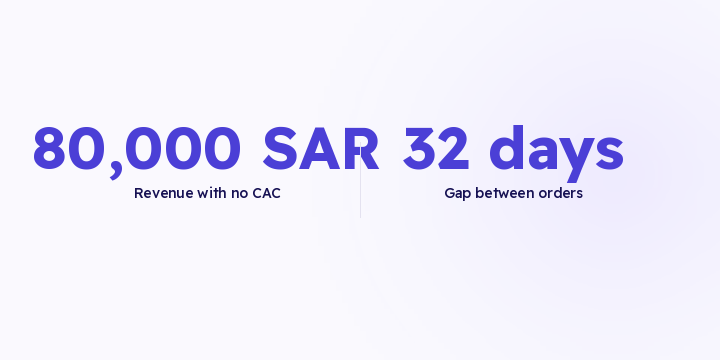
The second order has its own journey and its own channels, and it's the cheapest revenue you have. Here's the arithmetic, and the time gap that decides when to act.