

Analytics
How to move budget between channels without losing the gain
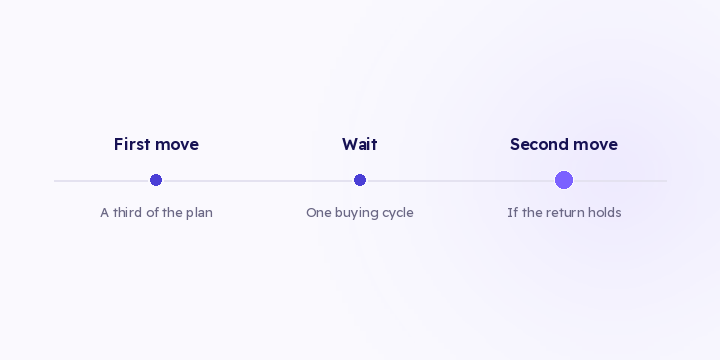
The distribution check tells you there's an opportunity. Moving it all at once eats most of it. Here are three execution rules, and what to watch afterwards.
2 min read
Most segmentation projects end in a chart that gets presented once and then forgotten.
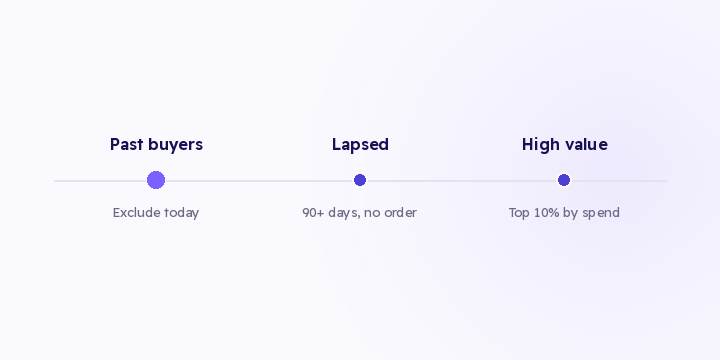
The test that separates useful from decorative is two questions: does this end in a list, and would you act on it this week? Three segments pass at almost every store, and all three come from order data you already hold.
Everyone who has bought from you, removed from your acquisition retargeting audience.
This is the cheapest win available and the one people forget, because it produces no report. Every day a buyer stays in that audience, you're paying to reach someone who is already past the purchase. The campaign then shows a healthy return, because it's being credited with orders from people who were coming back anyway.
Build it, export it, upload it as an exclusion, and refresh it. It takes an afternoon and starts saving money the same day.
Bought once, more than 90 days ago, never came back.
This list only comes out right if identity is resolved. Without that, the same person shows up as three profiles and none of them looks lapsed.
It's the segment with the best ratio of value to effort, because these are people who chose you once and cost nothing to acquire again. The size will surprise you: in a business with a 20% repeat rate, four out of five customers end up on this list.
Your best customers by spend or by order count, used as the seed for a lookalike audience.
Seed quality decides lookalike quality, and a seed along the lines of "everyone who added to cart" is a weak one. A tight seed of genuine repeat buyers usually outperforms a broad seed of all visitors, and the difference shows within a month.
This is also the segment most damaged by unresolved identity. Your best customers bought most often across the most devices, so they're the most likely to go missing from a seed built on raw records.
None of them needs a new tool. All three come from your order data once identity is resolved:
| Segment | Condition | Action |
|---|---|---|
| Buyers | Has ever purchased | Exclude from acquisition |
| Lapsed | One order, 90+ days ago | Win-back campaign |
| High value | Top 10% by spend | Lookalike seed |
All three conditions are things you can say in one sentence. That's the practical test for whether something should be a saved list rather than a weekly task hanging on one person.
In Flowfy, building these segments from your customer data and exporting the list is live: you set the conditions, purchase window, value threshold, acquisition channel and order count, and the member count comes back before you save. Automatic daily sync to the ad platforms is on the roadmap and hasn't shipped. Until it does, the routine is a manual export at a fixed time.
All three lists decay. Export once, upload, and forty-seven days later:
Any manual step that repeats gets done once or twice and then quietly stops. Put it in your calendar, or accept now that it will lapse.
Which do I build first? The exclusion. It saves money from the day you upload it and needs no campaign work.
When does a customer count as lapsed? After more than one typical repeat cycle. If your average gap between first and second order is 32 days, 90 days is clearly lapsed.
How big should the lookalike seed be? Big enough for the platform minimum, small enough to stay clean. When you have the choice, go tighter.
Can I invert the same conditions? Yes, and inverting is how the exclusion list gets built. That's why it's worth defining the conditions carefully once.
Build the buyer list today and upload it as an exclusion. A week later, build the lapsed list, try a reminder without a discount, and compare the result against an acquisition campaign run in the same week.
The distribution check tells you there's an opportunity. Moving it all at once eats most of it. Here are three execution rules, and what to watch afterwards.
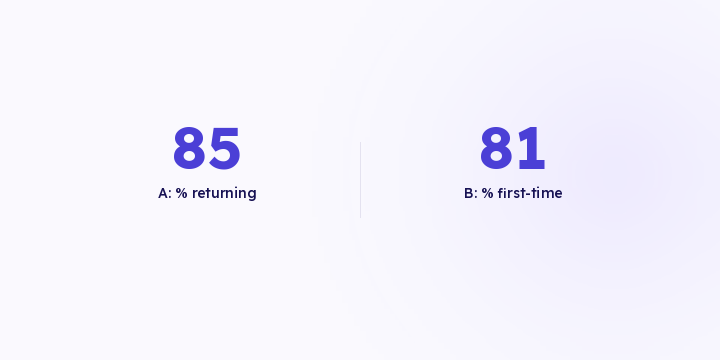
Two products with the same revenue can need opposite budgets. One buys you new customers, the other is why they come back. Revenue alone doesn't tell them apart.
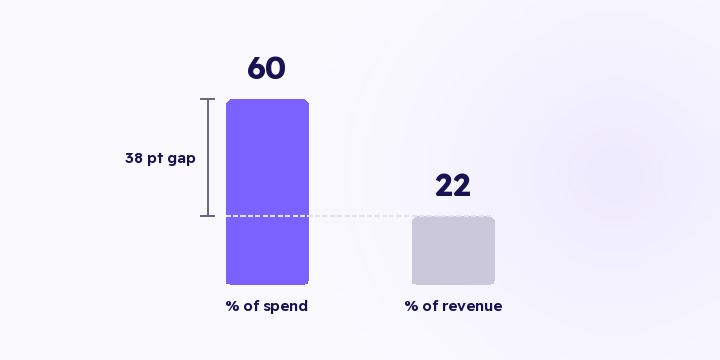
Tracking is fine and the money is going to the wrong place. That's the more common case, and it doesn't surface as an error anywhere. Here's the check, with the arithmetic.