How to move budget between channels without losing the gain
The distribution check tells you there's an opportunity. Moving it all at once eats most of it. Here are three execution rules, and what to watch afterwards.
The distribution check tells you 60% of budget is producing 22% of revenue. The arithmetic of moving 10,000 SAR looks compelling. You move it, and the gain doesn't appear.
The check was right. The problem is that the execution assumed something the check never claimed.
Moving 10,000 SAR from a channel at 0.94× to one at 5.0× models as 50,000 SAR of additional revenue against 9,400 SAR given up.
That calculation holds the receiving channel's return constant, and that rarely happens. As spend on a channel rises, it reaches a broader and less qualified audience, competes against itself in the auction, and saturates the segment that was converting at 5.0×.
So treat the number as a sizing tool. It tells you the move is worth trying and roughly how big it could be. It doesn't tell you the outcome.
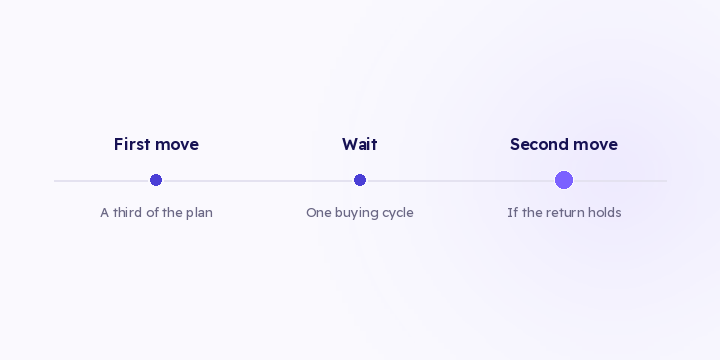
Move a third of what the model suggests. If the return holds at the new spend level, move again. Two smaller moves cost you an extra week and protect you from a channel that saturates at 40% more spend.
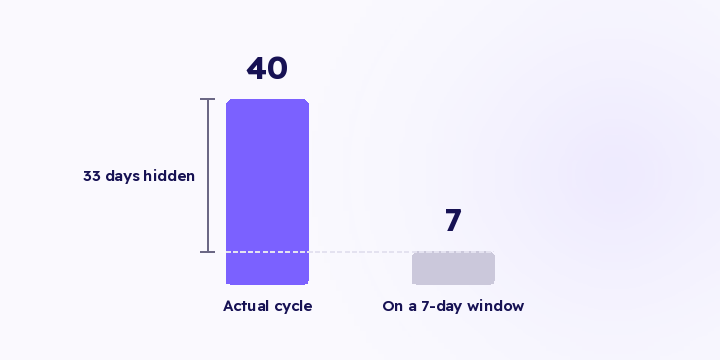
Wait a buying cycle between moves. If you judge a move after five days and your customers take three weeks to decide, you're judging the tail of journeys that were already running. See your buying cycle.
Change one thing at a time. If you move budget and swap creative in the same week, the next read won't tell you which one caused what.
The receiving channel's return, not its volume. Volume will rise because you gave it money. The question is whether the return held at the new spend.
Total orders, not attributed ones. If the channel you cut was opening journeys the other channel closes, your total order count can fall while both channels' attributed numbers look fine. That's the failure the distribution check can't see. See what a channel absence costs.
New customers specifically. Moving from an opening channel to a closing one usually improves blended return. It looks like a win for a month, and after a full quarter you notice new customers dropped.
Watch all three across a full buying cycle against the period before. Attributed revenue on its own will show a gain most of the time, because you moved money toward the channel your model credits more.
When the channels play different roles. A channel at 0.94× that opens journeys and one at 5.0× that closes them aren't comparable. Look at each one's share of first appearances in the journey before you treat the gap as misallocation. See sequence design.
When the losing channel is new. A campaign still in learning hasn't produced a real number yet.
When the gap is small. Under roughly ten percentage points of share, you're inside your own attribution noise.
As a general pace, monthly rebalancing is enough in a normal month. A weekly check mostly re-reads the same noise, unless daily spend is large enough that one week gives you a real sample.
Spend shares in the check come from your ad accounts today, because joining ad spend inside Flowfy is on the roadmap and hasn't shipped. See joining ad spend. Revenue by source, attribution trends and conversion paths are live, and they cover both the check and the post-move monitoring.
Run one third-sized move this month and judge it after a full buying cycle on total orders and new customers. If the receiving channel's return collapses in the first week, put the budget back. Since you only moved a third, reversing it doesn't cost you much.
The gap between first touch and purchase is a fact about your product that no benchmark supplies. It sets your attribution window, when you start spending before a season, and how long you wait before judging a campaign.
No attribution model answers this question. The only method is a holdout, and it costs real money. Here's how to design one and which channel deserves it.
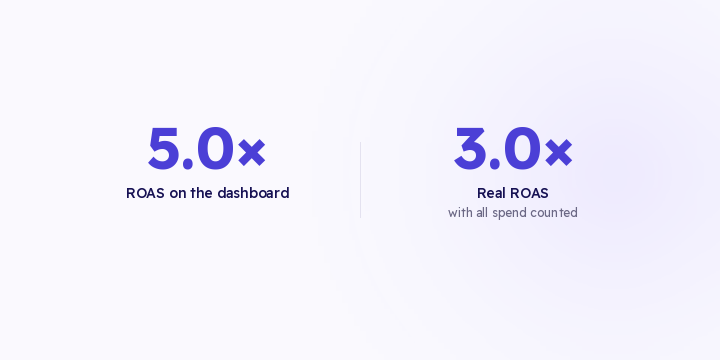
A 5.0 ROAS on the dashboard is worth checking before you celebrate. If 40% of your spend never matched a campaign, the denominator is short and the number is wrong in the direction you like.