Before you raise the budget on any campaign, check the margin on the product it sells.
Ads Manager counts sales. Your store counts orders. Neither one knows what the goods cost you. That's how you end up with a high-ROAS campaign eating your profit and a lower-ROAS campaign quietly paying for the month.
A store sells phone accessories and perfume. Two campaigns, 10,000 SAR each per month.
Accessories are a 49 SAR product. They sell a lot, at a 15% margin. Perfume is a 340 SAR product. It sells less, at a 70% margin.
| Sales | ROAS | Margin | After cost of goods | After ad spend |
|---|
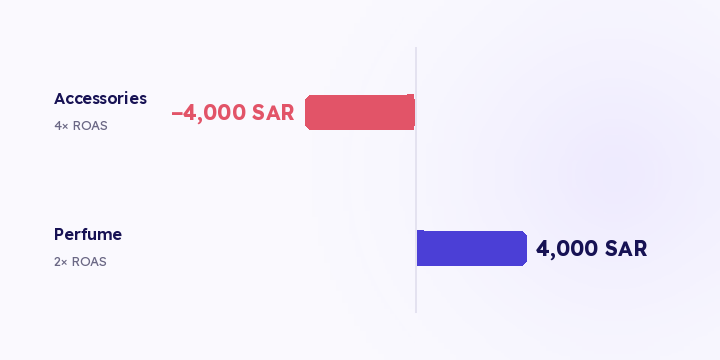
| Accessories | 40,000 SAR | 4× | 15% | 6,000 SAR | −4,000 SAR |
| Perfume | 20,000 SAR | 2× | 70% | 14,000 SAR | +4,000 SAR |
Illustrative figures.
Accessories sell four times as much and lose you 4,000 SAR. That's before shipping and gateway fees.
Sort that dashboard by ROAS, which is what most dashboards do by default, and you'll scale the first campaign and cut the second.
- Cost of goods. This is the big one, because it varies so much between products. 15% and 70% in the same store is normal.
- Shipping. Distant regions and heavy orders. An average hides exactly the orders doing the damage.
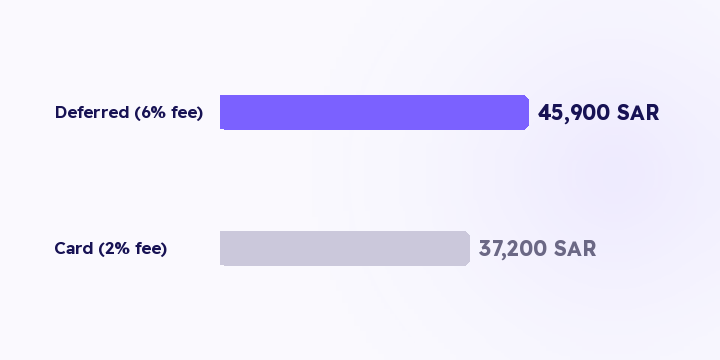
- Gateway fees. Instalment options cost more than a standard card.
- Returns. They rise during discount season, which is the month you spend the most.
Ads Manager doesn't show these because it was never sent them. It sees half the equation: what you spent and what came back.
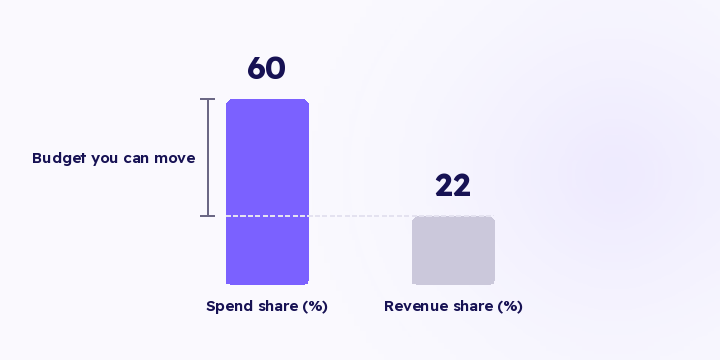
Cheap products are an easier decision, so they convert more. The algorithm sees a stronger signal and pushes budget toward them. More budget means more sales, which pushes ROAS higher again.
The result is a bigger operation without a bigger profit. More orders, more packing, more returns.
That's the pattern in a lot of accounts, though not all of them. If your products sit in a similar margin band, this matters much less to you.
You need a spreadsheet and one extra column.
List each product with its selling price and what it cost you. Pull last month's orders with the source attached to each one, and multiply. The campaign ranking will move.
Once you shift the split, watch three numbers for two weeks: total orders, total profit after costs, and new customer acquisition cost. If orders dipped and profit rose, the shift was right.
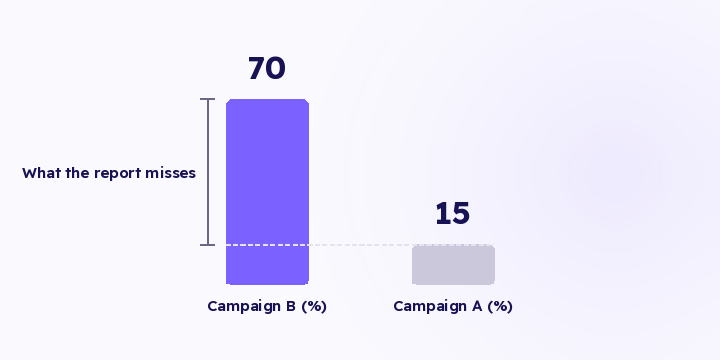
One condition before any of this: the revenue side has to come from your own orders, counted once. If you take the sales figure from platform reports, Meta, TikTok and Snapchat can each claim the same order, so you'd be starting the calculation from a number that's already too high.
Flowfy gives you that revenue side, with the source of each order counted once, and the connection steps are in the getting started guide. Storing cost of goods, shipping and gateway fees inside Flowfy to show profit per channel is on the roadmap and hasn't shipped. Until it does, the spreadsheet above works today.
Costs apply from the day you record them. They don't backfill onto orders that already shipped.
So if you start entering costs a month before the season, you can read that season by profit. Start after it, and you'll read it by revenue.
Before increasing any campaign budget, work out profit after cost of goods. If the ranking changes, move a small part of the spend first and watch orders and profit for two weeks before moving more.