

Analytics
How to move budget between channels without losing the gain
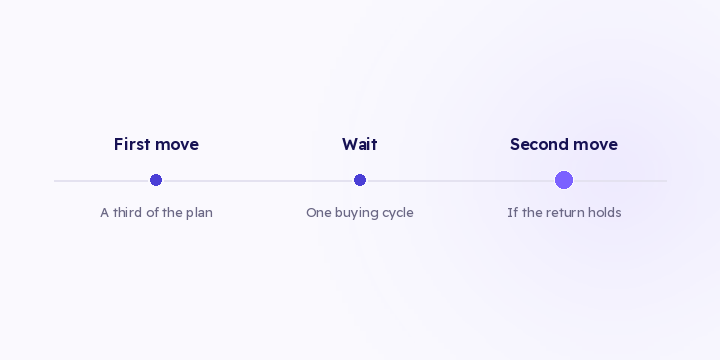
The distribution check tells you there's an opportunity. Moving it all at once eats most of it. Here are three execution rules, and what to watch afterwards.
2 min read
Most advertising conversation stops at one level: which channel to scale and which to pause. That level decides the budget, and nothing else.
Stock, bundles, offers and pricing are decided one level down, at the product. And an ad dashboard has nothing to say about any of them.
| Product A | Product B | |
|---|---|---|
| Monthly revenue | 40,000 SAR | 40,000 SAR |
| Orders | 200 | 160 |
| Average order value | 200 SAR | 250 SAR |
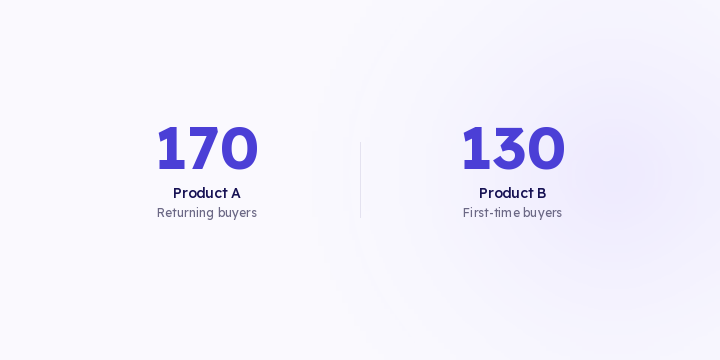
| Buyer type | 170 returning | 130 first time |
Illustrative figures.
Read revenue alone and they look identical, so they get the same decision. Read buyer type and you get two opposite decisions:
Reverse those two and you're paying for ads to sell to people you already have, while the product that brings you new people runs without support.
They give you revenue and orders per product, which is useful. What they don't give you is which channel brought each product's orders, and whether the buyer was new or returning.
Those two numbers are what separate an acquisition product from a retention product. Without them you have a list sorted by revenue, which is the same list that gets you scaling the wrong product.
Average order value doesn't fill the gap either. It's an indicator, not an answer. A high average can come from a bundle that loyal customers buy, or from an expensive product that people buy on their first visit. Buyer type separates the two; the average doesn't.
"Snapchat is underperforming" is an incomplete sentence. The complete one is that it's weak on this product and strong on that one.
Judging at the channel level alone gives you one big decision: pause or scale. Judging at channel and product together gives you the decision the situation actually needs, which is to keep the channel and point it at the product it sells.
This matters most in stores with a wide catalogue, because a single channel return there is an average across categories that have nothing in common. A channel at 1.8× can be 3.4× on one category and 0.9× on another, and the right move is to pull the second category out of the campaign rather than pause the channel.
It changes campaign briefs too. A campaign pointed at an entry-point product is an acquisition campaign with a cost-per-new-customer target. A campaign pointed at a retention product shouldn't be judged on new customers at all, because its audience has bought before.
The product at the top of the revenue report feels like the winning horse. In many cases it's on top because your existing customers buy it without any advertising.
Spending more on it buys orders that were coming anyway, and the campaign reports an excellent return precisely because repeat orders that used to arrive free are now credited to it.
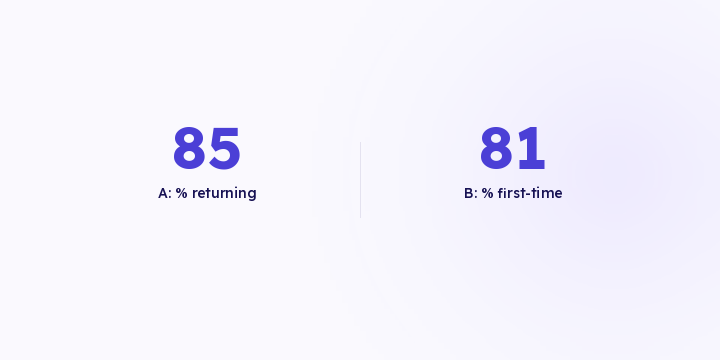
The signal that tells them apart is the ratio of new to returning customers on that product. A best seller whose buyers are mostly returning customers is a retention asset mislabelled as an acquisition opportunity.
Reading at the product level needs two things that most setups break:
Without the second, every product looks like an acquisition product, because every buyer looks new.
Both of those are live in Flowfy: the source on the order and identity resolution. The product analysis itself, meaning performance by product, by channel and product together, and new-versus-returning share per product, hasn't shipped. Until it does, the practical approximation is exporting orders with their source and customer attached and doing the split outside the tool. See the getting started guide for the line between what's live and what's planned.
Before you add budget to a product, look at who buys it. If most of its buyers are returning customers, the extra spend will buy orders that were already coming, and the better home for that product is existing-customer messaging.
The distribution check tells you there's an opportunity. Moving it all at once eats most of it. Here are three execution rules, and what to watch afterwards.
Two products with the same revenue can need opposite budgets. One buys you new customers, the other is why they come back. Revenue alone doesn't tell them apart.
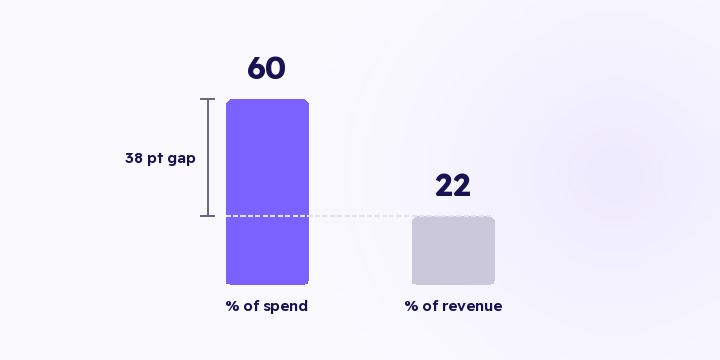
Tracking is fine and the money is going to the wrong place. That's the more common case, and it doesn't surface as an error anywhere. Here's the check, with the arithmetic.