
Growth
Measuring influencers without discount codes
A promo code counts who remembered to type it, not who was influenced. Here's what codes miss and what a tracked link measures instead.
3 min read
Creator settlement usually runs on a discount code, and a code measures one thing: who remembered to type it at checkout.
That's a smaller group than the people who watched the content and bought because of it. The difference between the two groups is big enough to flip a renewal decision.
Creator A and creator B, 10,000 SAR each.
By code: A brought 60 orders, B brought 12. The decision looks settled. Renew A, drop B.
By tracked source, it inverts:
| Orders | Revenue | Cost per order | Cost per riyal of revenue | |
|---|---|---|---|---|
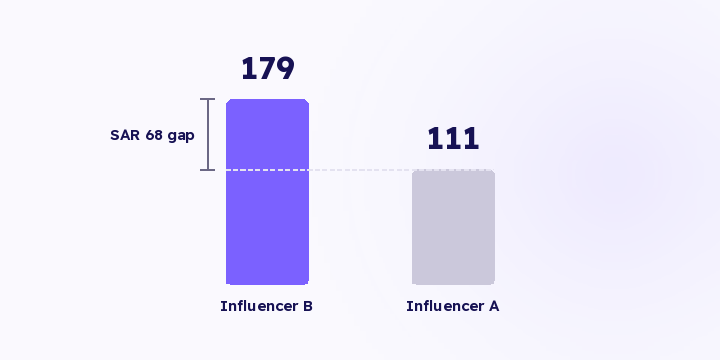
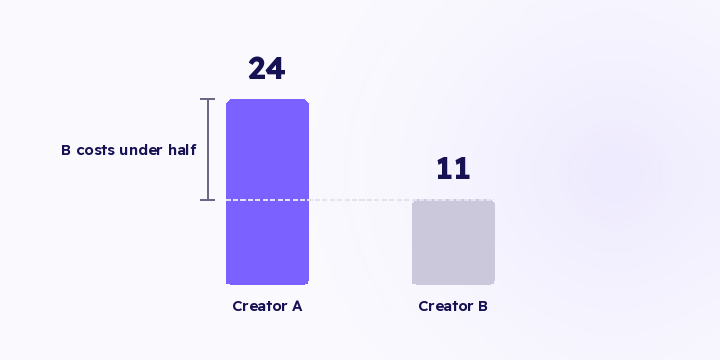
| Creator A | 74 | 41,000 SAR | ~135 SAR | 24 halalas |
| Creator B | 96 | 88,000 SAR | ~104 SAR | 11 halalas |
B's audience bought days later, without a code, with a bigger basket. On cost per riyal of revenue, B comes in at under half of A.
The fee didn't change between the two views. The ruler changed, and the ruler is what decided whose contract gets renewed.
A code asks for a chain of steps: watch the content, remember the code, come back to the store, type it at checkout. Every step loses people, and the losses aren't spread evenly across creators.
A creator whose audience follows offers and buys immediately gets a code that works well. A creator whose audience discovers, thinks about it, and comes back days later at full price gets a code that undercounts. The second audience is usually the one with the larger basket.
So the bias runs in a consistent direction. Codes reward discount hunters over higher-intent buyers.
Cost per riyal of revenue, not cost per order. Two creators can deliver a similar order count with very different basket values, and revenue is what pays the fee.
Orders inside your attribution window. A purchase that happens days after the post still goes back to the creator if the source is stored on the order. Flowfy stores it on a 90-day window, including the trip through a payment redirect. A per-creator link manager, with generated links and a separate view for each creator, is on the roadmap and hasn't shipped. Today you build a tagged link per creator with any link builder.
New customers on their own line. A creator whose audience is already your customer base is being paid to reach people you have. Split new from returning before you renew.
Most disputes with creators start because both sides counted differently after the month closed.
Put three things in the agreement before anything goes live: the tagged link they'll use, how long after the post orders still count, and whether the fee covers all orders or new customers only. The code stays for the audience, but the settlement number comes from the link.
After the first month on the new ruler, compare both creators on that same ruler before you move budget between them. A creator who looked weak on codes needs a full month on links before you judge them.
The code is useful as an offer and audiences expect it. What changes is that you stop calculating the fee from it.
The gap between code-attributed orders and source-attributed orders is useful on its own. When it's wide for a creator, that audience buys after thinking rather than on impulse. More on that in tracking creators.
At renewal time, pull cost per riyal of revenue for each creator from your own store orders, with new customers split from returning. If that ranking differs from the code ranking, renew on the second one.
A promo code counts who remembered to type it, not who was influenced. Here's what codes miss and what a tracked link measures instead.
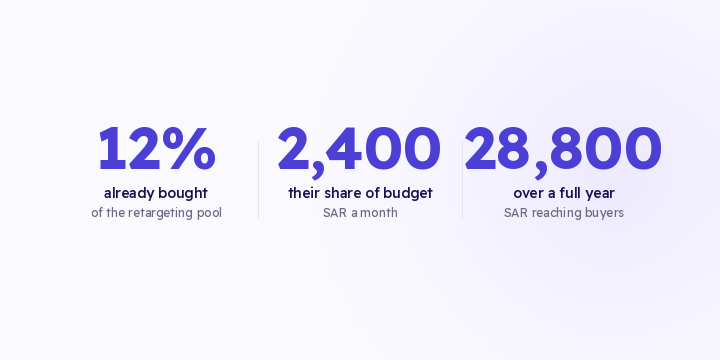
12% of a retargeting audience has already bought, and their share of the budget is 2,400 SAR a month. The waste never shows up as a loss anywhere, which is why it runs for years. Here's the arithmetic and the exclusions to run.
A blended repeat rate mixes a customer of three weeks with a customer of two years. Grouping people by when they arrived turns a static number into a curve you can act on. Here's the idea and three objections to it.