
Attribution
First touch and last touch, what each one answers
The two aren't measuring the same thing. What each one says, where each one is wrong, and how to read the difference between them per channel.
3 min read
Most of your measurement decisions rest on one number almost nobody looks up: how long your customers take between discovering you and buying.
It's measurable in an afternoon, and it settles several arguments at once.
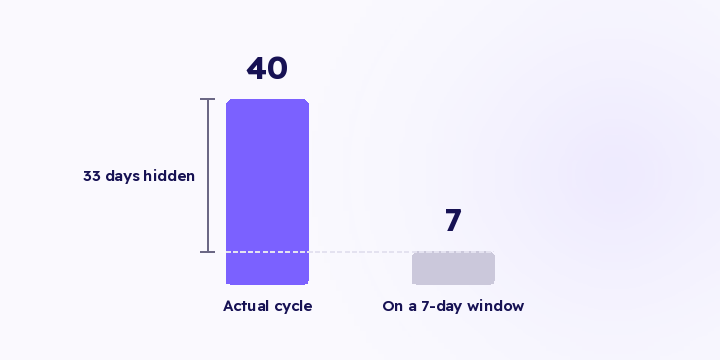
You can't measure a 40-day cycle with a 7-day window. Touches older than the window are never recorded as touches, so the measurement returns a cycle no longer than the window itself, every single time.
You end up with a conclusion that looks settled and is entirely circular: "our customers decide quickly", taken from a tool that can't observe them deciding slowly.
The same applies to identity. If one customer appears as three profiles, each fragment starts at its own first touch, so you're measuring the length of a fragment rather than the length of a journey.
In Flowfy, touches are stored with timestamps for each order over a 90-day window, tied to a resolved identity. That makes the first-touch-to-order gap readable per order and per channel.
Pull the last three months of orders and, for each one, take the difference between the first touch date and the order date. Then read three numbers:
That third number is your practical window. Everything past it is real but not worth optimising for.
Don't read the average. A store where most orders close same-day, with a long tail of people taking forty days, will report an average of about a week. That number describes none of your customers.
Your attribution window. If a meaningful share of your orders sit beyond 30 days, a 30-day window is deleting real credit every month, and deleting it specifically from discovery channels.
When you start spending before a season. If your typical cycle is three weeks, a campaign launched the week before the season buys customers who'll convert after it ends.
How long to wait before judging a campaign. Judging a new prospecting campaign at day seven, when your cycle runs to thirty, measures noise. It's the most common reason a working campaign gets cut.
How long to wait before judging a cohort. If the average gap between first and second order is thirty-two days, reading a cohort at week two tells you nothing. See cohorts.
The overall figure hides useful variation. Branded search journeys are short by nature, because the customer had already decided before they searched. Paid social prospecting journeys are longer, because the customer hadn't heard of you an hour earlier.
That difference explains a large part of the first-versus-last gap, and it means one global window can be right for one channel and too short for another.
The cycle itself is a property of what you sell: the higher the order value, or the newer the category is to the buyer, the longer it runs. So trying to shorten it is usually a worse investment than measuring it properly and planning around it.
The two aren't measuring the same thing. What each one says, where each one is wrong, and how to read the difference between them per channel.
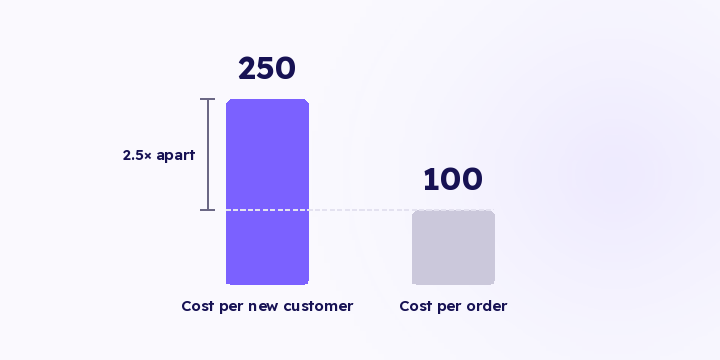
Spend divided by all orders flatters every campaign that resells to your own customers. Here's the arithmetic, and the order to work through to LTV by channel.
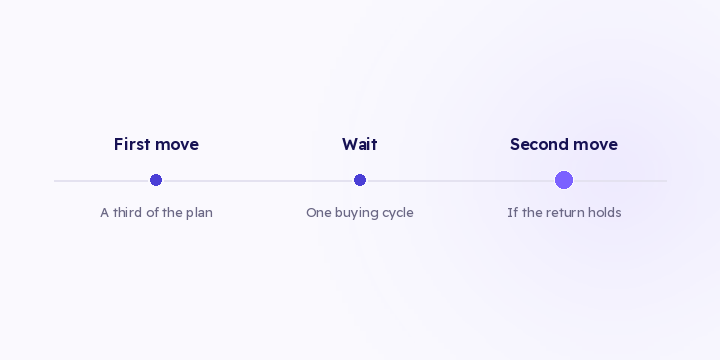
The distribution check tells you there's an opportunity. Moving it all at once eats most of it. Here are three execution rules, and what to watch afterwards.