
Attribution
How to find out how many orders you lose if a channel stops
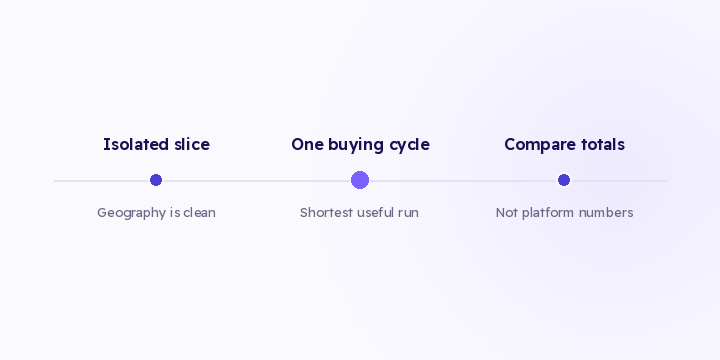
No attribution model answers this question. The only method is a holdout, and it costs real money. Here's how to design one and which channel deserves it.
3 min read
Once you can see the full journey behind every order, a new metric becomes available: how often a channel appears in paths that ended in a purchase.
High frequency feels like high importance. It's a different measurement, and confusing the two puts budget in the wrong place.
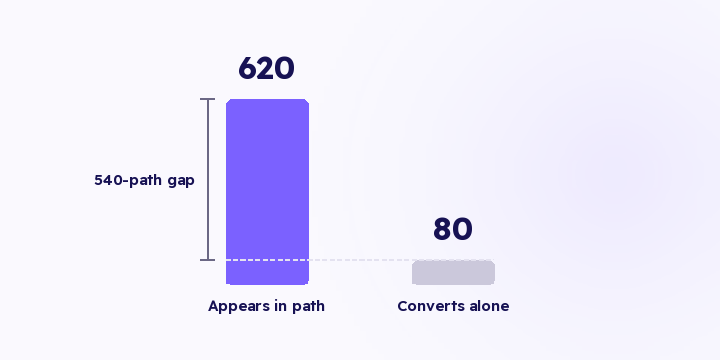
Take 1,000 conversion paths over 90 days. Channel A appears in 620 of them. Of those, 540 have a paid search immediately after it, before the purchase. Only 80 converted with Channel A alone.
The same data gives you three readings:
Its role is real, but it's an opening role. Score it on closing ROAS and you'll cut a channel that's doing useful work. Score it on frequency and you'll hand it more budget than it earned.
A channel can appear in many paths for reasons unrelated to influence:
Broad reach. A channel with wide targeting appears in a large share of paths simply because it reaches a lot of people, including the ones who were going to buy anyway.
Retargeting placement. A retargeting channel appears in nearly every path by construction, because it's shown to people already in the journey. Its frequency sits close to 100%, and its contribution is only whatever it added to people already moving.
A long window. With a 90-day window, a channel that touched someone three months ago still shows up in that person's path.
None of these is a reason to cut the channel. All of them are reasons not to read frequency as importance.
Not how often the channel appeared. The question is what happens to the path when it's absent, and there are two answers at different costs.
Cheap and approximate: the solo rate. What share of paths containing the channel converted with it as the only touch. Those 80 paths are the clearest evidence of self-sufficient contribution you can get from your own data.
Expensive and definitive: a holdout. You pause the channel for one region or one audience and read total orders rather than attributed orders. Details in what a channel's absence costs.
There's a third quick check: the opening share. If a channel is first in most of its paths, it isn't closing your orders, it's starting them. Any channel sitting near the moment of purchase will look excellent under a single-touch model, whether that's retargeting, brand search or a cart email.
In Flowfy, conversion paths are stored with their ordering over a 90-day window, so appearance share, first-appearance share and solo-conversion share are all computable from stored data. The packaged view that ranks channels by contribution rather than appearance is on the roadmap and hasn't shipped.
Is a high solo rate good? It's strong evidence of self-sufficiency. It can also mean the channel reaches people whose intent was already high, which is worth knowing but isn't the same as creating demand.
How do I compare a retargeting channel fairly? Against the audience it was shown to, not against prospecting. The two aren't comparable on a single metric.
What about high frequency and a low solo rate? That's an assist channel. Fund it as one, and don't expect it to look good under any single-touch model.
Does a longer window inflate frequency? Yes, mechanically. That's a reason to read frequency carefully, not a reason to shorten the window. See the 90-day window.
Before any budget decision on a channel, put two numbers side by side: its appearance share and its solo-conversion share. If the gap between them is large, it's an opening or assist channel, and its place in the budget should be decided on opening work rather than on closes.
No attribution model answers this question. The only method is a holdout, and it costs real money. Here's how to design one and which channel deserves it.
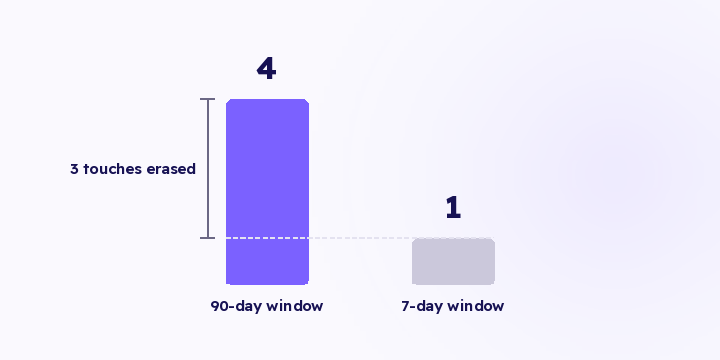
A model can only divide the touches it can see. Before arguing about first versus last, check how far back your window reaches, because a short one erases the whole subject of the argument.
Most arguments about channel performance aren't arguments about data. Identify the type first, because only one of the three is settled by opening a record.