

Attribution
How fourteen identifiers become one customer
A phone visit and a laptop purchase are two separate records. Here's what merges them, why backfilled history changes your attribution, and what moves in your numbers afterwards.
3 min read
Teams spend weeks choosing between attribution models and no time at all on the setting that decides what any model has to work with. That setting is the window length.
The window is the maximum age of a touch that's still eligible for credit. Anything older isn't weighted lower. It isn't there at all.
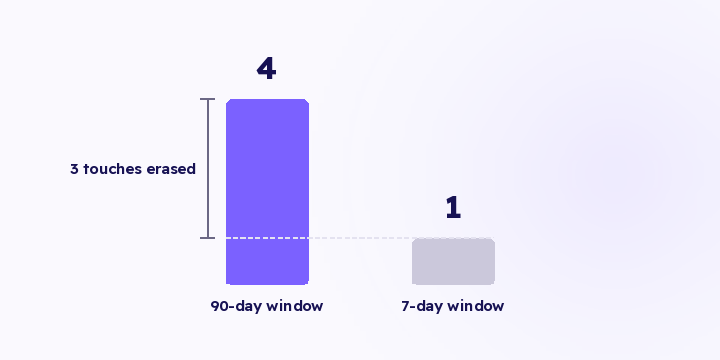
So with a 7-day window, a customer who takes 40 days to decide has their opening touch erased. Awareness campaigns, creator links and slow-working content all read as zero.
Take a journey with four touches, the oldest of them 40 days before the purchase:
| 7-day window | 90-day window | |
|---|---|---|
| Touches visible | 1 (the close) | 4 |
| First touch credits | The close | The real opener |
| Linear credits | The close | Four touches |
| Position-based credits | The close | Opener and closer |
Under the short window every model produces the same answer, because there's only one touch to divide. You can spend a month comparing models and the choice will be meaningless, because the window already turned a multi-touch journey into a single-touch one before any model ran.
That's why stores with short windows conclude that attribution models don't matter. In their data they genuinely don't, and the models aren't the reason.
The erasure isn't random. It removes early touches specifically, which means it removes discovery specifically.
The channels that lose out are the ones whose job is opening: awareness video, creator content, broad prospecting, anything aimed at people who haven't heard of you. The channels that benefit are the ones standing next to the purchase: retargeting, brand search, email.
A store optimising under a short window drifts, month after month, toward spending only on harvesting. The decline then arrives without warning, because the report showed improvement the whole way down.
Don't copy a benchmark out of an article. Measure the gap between first touch and purchase across your own orders, and look at the distribution rather than the average.
The question isn't what's typical, it's where the tail stops mattering. If 95% of your orders have their first touch within 30 days, a 30-day window costs you little. If a meaningful share sit beyond 60 days, a short window is deleting real revenue attribution every month.
That measurement has a condition: you need a long window to run it. A 7-day window can't tell you whether you need a longer one, because the evidence was thrown away before you got to it. That circularity is why the default should be long. Flowfy runs a 90-day window and stores the full touch sequence per order, so a period can be re-read under any model without re-collecting.
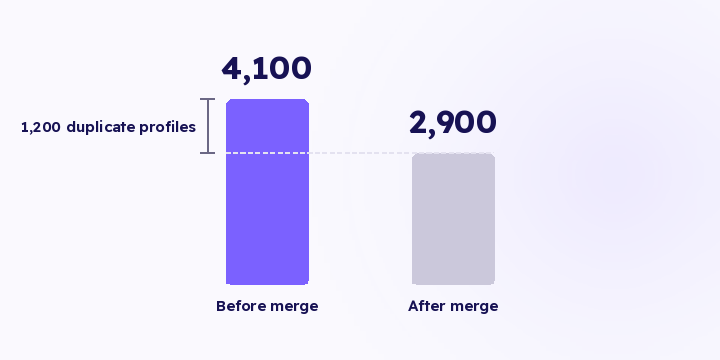
A window is only as good as the identity behind it. Holding 90 days of touches is useless if the customer appears as three profiles across that time, because each profile carries a fragment of the journey and no model can reassemble them.
Long window plus resolved identity is the combination, and either one alone falls short. In Flowfy identity is resolved across fourteen identifier types. More on that in identity resolution.
A phone visit and a laptop purchase are two separate records. Here's what merges them, why backfilled history changes your attribution, and what moves in your numbers afterwards.
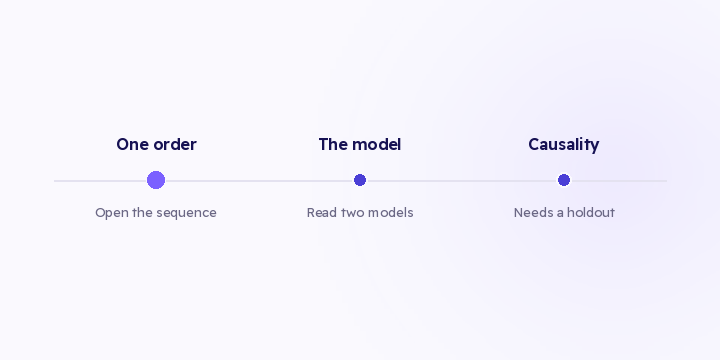
Most arguments about channel performance aren't arguments about data. Identify the type first, because only one of the three is settled by opening a record.
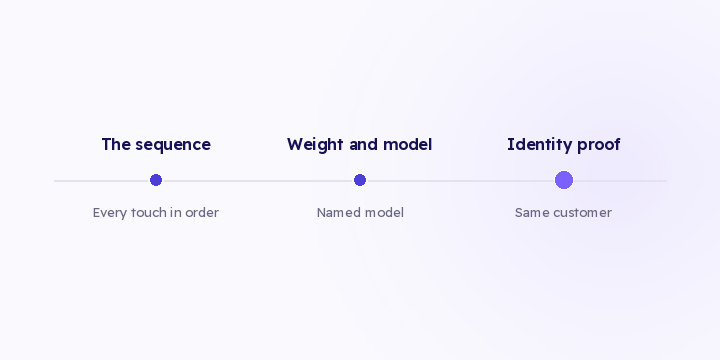
An 890 SAR order credited to a channel you didn't spend on this month. If you can't explain why, that number dies and takes every other figure from the same source with it.