

Attribution
Measure your multi-touch share before you pick a model
For single-touch orders, every model returns the same answer. So the share of orders with more than one touch is the size of the decision you're debating.
2 min read
A ranked channel list assumes every channel does the same job and competes for the same place. Once you can see the order channels appear in inside a path, a more useful question replaces the ranking: what is each channel for?
| Number | What it tells you |
|---|---|
| Share of paths where it appears first | Opening work |
| Share of paths where it appears last | Closing work |
| Share of paths where it's the only touch | Self-sufficiency |
A channel that appears first in most of its paths is an opener, one that appears last is a closer, and one that's frequently the only touch does both. That third number is the one most stores never compute, and it's the most useful of the three: a channel that closes on its own needs no support and can be scaled with the least risk.
Openers. Broad prospecting, awareness video, creator content. The mistake is judging them on close rate, cutting them, and then watching total revenue fall by more than their attributed share.
Closers. Retargeting, brand search, cart email. The mistake is scaling them to grow. They harvest demand that already exists, so more budget harvests the same pool faster, and then it runs dry with no warning.
Self-sufficient. They open and close within one touch. The mistake is under-investing because their attributed volume looks unremarkable next to a channel that appears in many paths.
Assists. They appear in the middle, rarely first or last. The mistake is cutting them first, because they never look responsible for anything under any single-touch model.
Sequence the spend rather than ranking it. An opener and a closer aren't competing for the same riyal, and cutting the opener to fund the closer shrinks the pool the closer harvests from. The effect reaches you a month later, and almost nobody traces it back to the decision that caused it.
Match the metric to the role. Openers are judged on new customers and first-touch share, closers on close rate and cost per order. Apply one metric to both and one of them is being measured wrongly.
If you want to test whether a channel matters, pause an opener rather than a closer. Pausing an opener produces a legible effect on total orders once your buying cycle elapses. Pausing a closer produces an immediate drop that says nothing about cause, because the demand was already there.
Longer paths mean longer consideration, which means more room for openers to matter. If most of your paths are a single touch, this whole framework applies to a minority of your revenue, and your effort belongs on collection instead. See when multi-touch is worth it.
Path length also varies by channel: search paths are short, social prospecting paths are long. A single global conclusion about your store usually hides two opposite truths.
In Flowfy, conversion paths are stored with their ordering intact over a 90-day window, so first-appearance, last-appearance and single-touch shares are all readable per channel. The packaged view that scores channels by role rather than volume is on the roadmap, while the path data itself is readable today.
The first thing to pull from it is the single-touch share for your three largest channels. If one comes out high there while its attributed volume looks average, that's your lowest-risk scaling move this month.
For single-touch orders, every model returns the same answer. So the share of orders with more than one touch is the size of the decision you're debating.
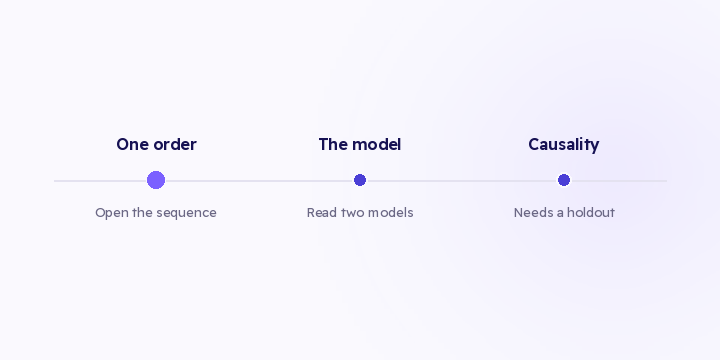
Most arguments about channel performance aren't arguments about data. Identify the type first, because only one of the three is settled by opening a record.
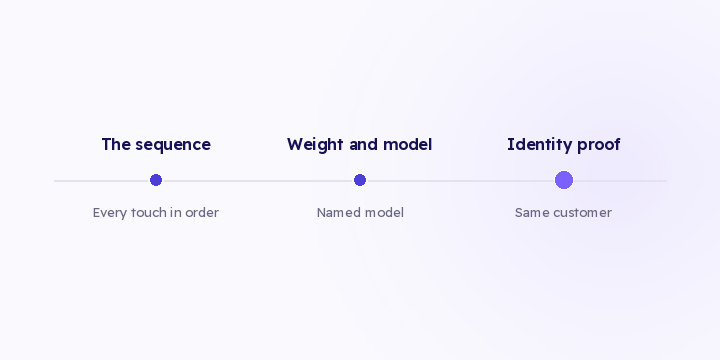
An 890 SAR order credited to a channel you didn't spend on this month. If you can't explain why, that number dies and takes every other figure from the same source with it.