

Seasons
Reading a season while it runs, not after it
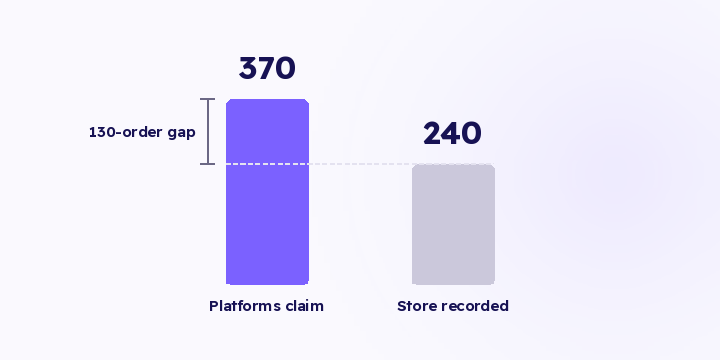
On peak night you split 30,000 SAR using numbers the platforms reported about themselves. Here's the arithmetic of that gap, and what to watch each day instead.
3 min read
Most reporting hands you a table and asks you to build the picture yourself. That works at four rows and fails at twenty, which is where most stores land once campaigns and sources are counted separately.
Revenue moving from channels into orders, with the width of each line carrying its volume. Read left to right, or right to left in Arabic, it shows the whole month's composition as a shape rather than a list.
It answers one question faster than any table: where is my money coming from right now. A large difference between channels is visible before you read a single figure, because the eye compares widths without being asked.
That's its only job. It isn't a precision instrument, and reading exact values off it is the wrong use.
The flow is a snapshot. It can't tell you whether a channel reached its current width on the way up or on the way down.
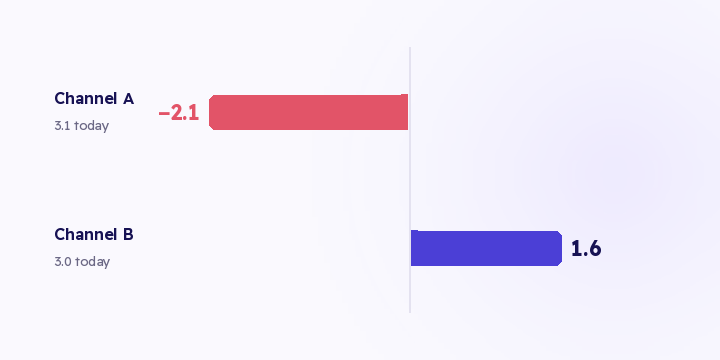
Take two channels sitting at close to the same return today:
| Today | Eight weeks ago | |
|---|---|---|
| Channel A | 3.1 | 5.2 |
| Channel B | 3.0 | 1.4 |
In the period table the difference is 0.1 in A's favour, and any quick review says put more into A. In the trend the story inverts: A has fallen 40% in eight weeks and B has more than doubled. If both hold their path, and that's an assumption rather than a promise, A drops below 2 and B passes 4.
It's the same data both times. The table gives you one point in time, and the trend gives you the path the channel took to get there.
Flow first, to find where the volume is: which channels actually matter this month, and which are small enough to stop discussing.
Trend second, on the three or four channels carrying your revenue.
The table last, for the exact figures behind a decision you've already framed.
If the flow shows one channel carrying half your revenue, that's the first trend to open, because any movement in it moves the whole month with it.
Most stores work in reverse and start from the table, which is why a channel review takes an hour and produces a ranking instead of a decision.
Too short and you're reading noise; too long and you miss the turn.
The practical rule is at least three typical buying cycles. If your customers take about ten days to decide, four weeks is the shortest lookback that separates a trend from a fluctuation. Below that you're mostly watching campaign learning phases and day-of-week seasonality.
During a season, shorten it, but expect more noise and act only on large moves. See reading a season while it runs.
And if a trend reverses right after you act on it, your lookback was too short for your volume. Lengthen it rather than concluding that trends don't work.
Attribution flow and trends are both live in Flowfy today, running over stored journeys attributed on your side within a 90-day window. Joining ad spend from the ad accounts, which is what turns a revenue trend into a return trend, is on the roadmap and hasn't shipped. So today you take the spend figure from your ad accounts and set it beside the revenue figure from Flowfy.
If you display attributed revenue next to platform-reported conversions, the two will diverge. That divergence is useful in itself. See why Meta reports more conversions.
Before moving budget between two channels, look at the eight-week trend for each of them. If the gap between them in the period table is small, take the decision from the trend rather than the table.
On peak night you split 30,000 SAR using numbers the platforms reported about themselves. Here's the arithmetic of that gap, and what to watch each day instead.
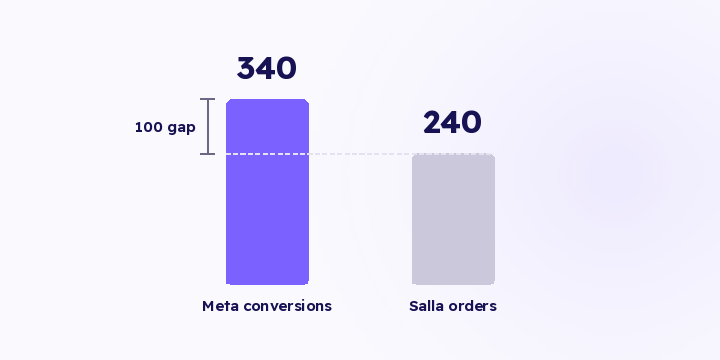
340 against 240, and both numbers are right. Four reasons the gap exists, how to measure it in your store, and which number to budget on.
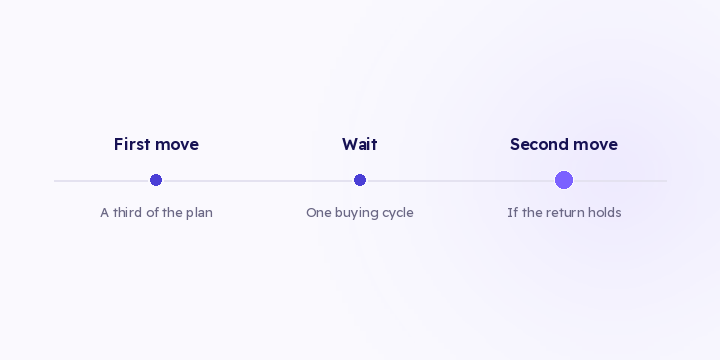
The distribution check tells you there's an opportunity. Moving it all at once eats most of it. Here are three execution rules, and what to watch afterwards.