

Attribution
How to settle an attribution argument by opening one order
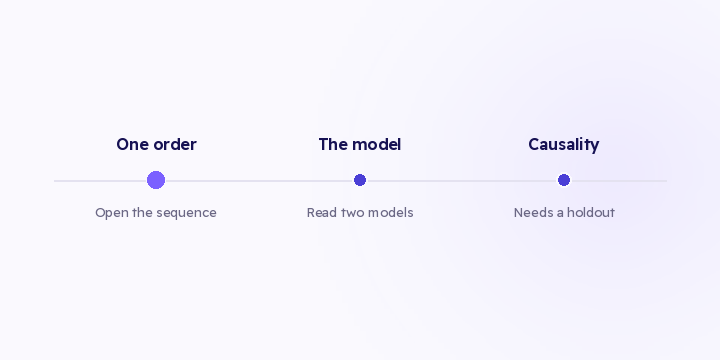
Most arguments about channel performance aren't arguments about data. Identify the type first, because only one of the three is settled by opening a record.
2 min read
Two questions come up in a budget meeting. The first is how to divide credit in a way everyone can agree with. The second is narrower: of the money we spent, what closed? The three standard multi-touch models don't answer the second one. Two others do, one for each question.
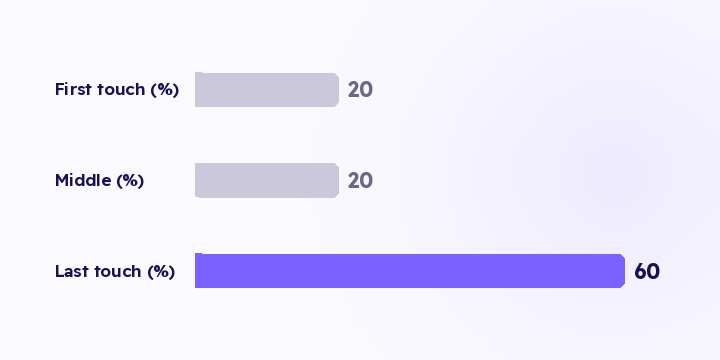
Position-based splits credit 40/20/40 across the start, middle and end of a journey. J-shaped tilts that curve toward the close, commonly something like 20% to the first touch, 20% across the middle and 60% to the last.
The assumption is that discovery matters and deserves recognition, but that in this category the real work happens at the close.
It fits when your final interaction is doing heavy lifting: a strong offer, a well-timed reminder, a checkout that converts.
This one is structurally different. It asks which of the paid interactions in a journey came last. Organic touches such as brand search, direct visits and email to existing customers are skipped by the calculation entirely.
The assumption isn't that organic doesn't matter. It's that organic isn't a budget decision. You're not choosing how much to spend on someone typing your domain name into a browser.
Where it genuinely helps:
| Model | Question it answers | Use it for |
|---|---|---|
| J-shaped | How credit divides with the close weighted | General reporting |
| Last paid touch | Of what I spent, what closed | Paid budget allocation |
A channel that looks strong on last paid and weak on J-shaped is closing paid journeys that organic touches also assisted. A channel strong on J-shaped and weak on last paid is opening journeys that close organically, which is exactly the pattern that gets awareness campaigns cut.
In Flowfy both models run over the same stored journeys inside a 90-day window, alongside the rest, so you can read one period under both and compare.
Because it skips organic, it makes the paid share of your business look bigger than it is. Report last-paid numbers to someone who assumes full-journey attribution and you'll overstate what advertising is doing.
The fix is naming the model every time you present a number. "ROAS was 3.2" doesn't mean anything on its own. "ROAS was 3.2 on last paid touch" means something specific.
Which one should be my default? J-shaped if you want a single general model. Last paid touch as a second view, specifically when allocating paid budget.
Does J-shaped have a standard weighting? There's no agreed one. What matters is fixing it and stating it, so your periods stay comparable.
Can I pay creators on last paid touch? Only if the creator link is the paid touch. If a creator opens journeys that close on paid search, last paid touch credits the search and pays the creator nothing.
Use last paid touch only in the paid allocation meeting, and read J-shaped alongside it in the same session. Whatever number comes out of either, write the model name next to it.
Most arguments about channel performance aren't arguments about data. Identify the type first, because only one of the three is settled by opening a record.
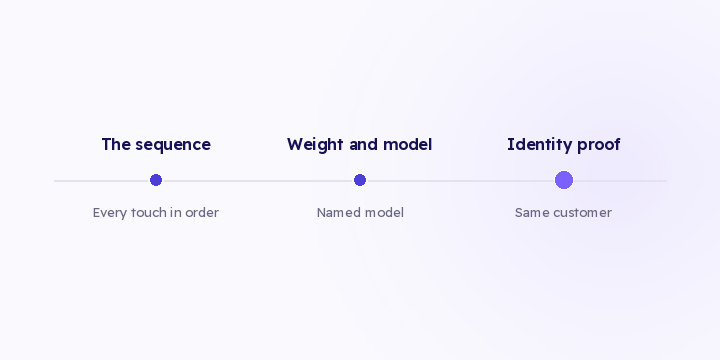
An 890 SAR order credited to a channel you didn't spend on this month. If you can't explain why, that number dies and takes every other figure from the same source with it.
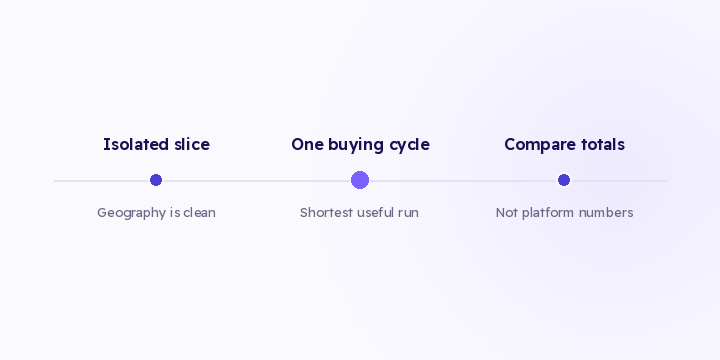
No attribution model answers this question. The only method is a holdout, and it costs real money. Here's how to design one and which channel deserves it.