

Attribution
How fourteen identifiers become one customer
A phone visit and a laptop purchase are two separate records. Here's what merges them, why backfilled history changes your attribution, and what moves in your numbers afterwards.
3 min read
During a season you spend more than usual to reach people buying more than usual, and a large share of them have never bought from you before. Most stores still judge the season on cost per order.
The problem is the denominator, not the spend.
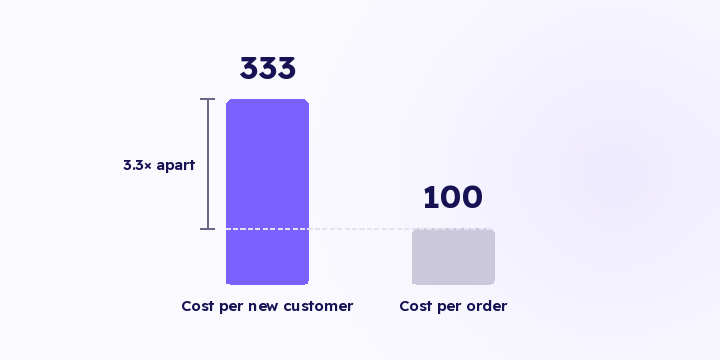
A campaign spends 40,000 SAR during the season and produces 400 orders. Divide spend by orders and you get 100 SAR per order.
Now split those orders by customer type: 120 new customers, and 280 orders from people who were already yours. Divide the same spend by new customers alone and you get 333 SAR each.
Same campaign, same spend. One number says raise the budget, the other says check the targeting first. Which one you take depends on what you wanted the season to buy. If the answer is customers, 333 is your number, and 100 is crediting you for sales to people you already had.
Your existing customers buy more during a season too. The returning share of orders rises in exactly the month your spend rises, so blended cost per order improves for a reason that has nothing to do with acquisition efficiency.
A store reading cost per order alone leaves every season with the same conclusion: the advertising got better. What happened is that its own customers bought.
It depends on what that customer is worth afterwards.
If a new customer from this channel is worth 900 SAR over a year, the campaign deserves more budget. If they're worth 300 SAR, you paid 333 to earn 300. The blended 100 SAR figure couldn't tell those two cases apart.
So the readout needs a second step. Take the customers who arrived during the season as one group, and check how many came back after a month and after two months, split by the channel that brought them. A channel whose season customers return is worth a higher acquisition cost.
Before any of that you need a clear definition of a new customer: first-ever order, on a resolved identity. Without identity resolution, a returning customer buying on a second device counts as new and inflates the number — see identity resolution.
Seasons are usually discounted, which makes a new customer's first order the least profitable order you'll get from them. That's fine if they return at full price and a problem if they don't. So the test isn't the season itself. It's the two months after it, split by acquisition channel.
One caution: don't judge every campaign on new-customer cost. Retargeting exists to sell to existing customers, and judging it on new customers is as wrong as judging prospecting on cost per order.
Order-level source, identity resolution and customer records are live in Flowfy today, so new versus returning is readable per campaign. Cohort retention curves and lifetime value by first acquisition channel are on the roadmap and haven't shipped — see nCAC and cohorts. Joined ad spend hasn't shipped either, so the spend side comes from your ad accounts.
Until they do, the manual version works: export the season's orders with customer and source, separate new from returning, and divide spend by the new-customer count.
Divide the finished season's spend by its new customers before you set the next season's budget. Then check the same group two months later and see how many came back.
A phone visit and a laptop purchase are two separate records. Here's what merges them, why backfilled history changes your attribution, and what moves in your numbers afterwards.
Spend divided by all orders flatters every campaign that resells to your own customers. Here's the arithmetic, and the order to work through to LTV by channel.

Last 7 days, last 30 days, this month. All three were chosen for convenience, not for a question. Here's how to pick the range from the question you actually have.