

Attribution
How to settle an attribution argument by opening one order
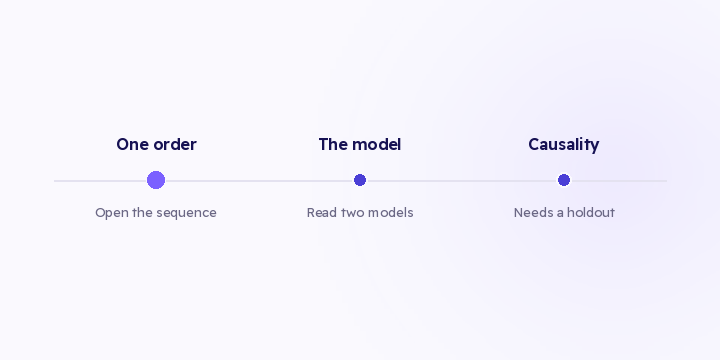
Most arguments about channel performance aren't arguments about data. Identify the type first, because only one of the three is settled by opening a record.
2 min read
"Why was this order credited to Snapchat?" is the most common question a merchant asks the first time they open an attribution report. A source name on its own convinces nobody, least of all when the named channel is one you didn't spend on this month.
The answer isn't a more precise number. It's the order of the steps that led to the order.
Conversion paths show the channel combinations that end in a purchase, ranked by how often each one repeats. The order inside the path is what a channel table can't express.
An illustrative month with 1,000 conversions:
| Path | Conversions |
|---|---|
| Snapchat alone | 180 |
| Snapchat then Google | 260 |
| Snapchat then WhatsApp | 150 |
| Paths without Snapchat | 410 |
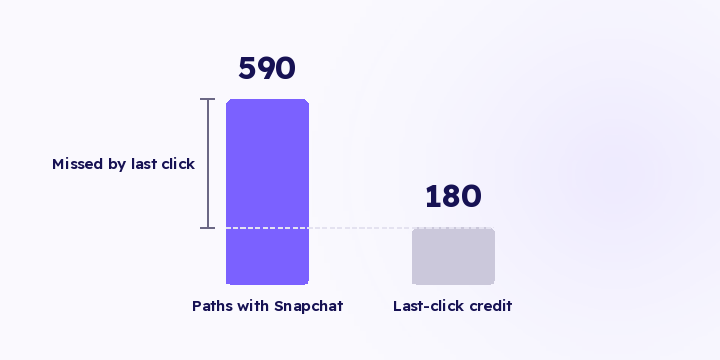
Snapchat appears in 590 of the thousand, and last click credits it with 180.
That doesn't mean it deserves the full revenue of all 590. It means 180 is an incomplete number. The useful detail is in the ordering: in 410 of those 590, Snapchat was the first step rather than the last.
The second trap runs opposite to the first. A channel that shows up in 62% of purchase paths looks indispensable, until you ask what happens to the path without it.
Take 1,000 paths over 90 days:
Three readings of the same numbers. Last click gives it only the orders it closed, so it looks weak. Frequency says it's in 62% of paths, so it looks like the hero. The third reading is the useful one: 80 paths needed nobody after it, and 540 needed a second step to close.
So its role is opening the path rather than closing it, and judging it on closing return damages the channel and the budget together.
In practice, a path-opening channel is judged on how many paths it started and what starting one costs, not on last-click return. And if you cut it because the direct return looks weak, expect the effect to show up weeks later in brand search volume and in the volume of the campaigns that close, rather than in the same week.
The second half of the question sits at the level of a single order. An order worth 1,240 SAR, with a stored path:
| Model | Search | ||
|---|---|---|---|
| First touch | 1,240 SAR | 0 | 0 |
| Last touch | 0 | 0 | 1,240 SAR |
| Position based | 496 SAR | 372 SAR | 372 SAR |
Same order, same data, three different results. All of them are correct, as long as you know which model is running.
And once you see the weight written next to each touchpoint, the question changes. You stop asking whether the number is right and start asking whether the model fits your purchase cycle.
In Flowfy, conversion paths are live, and every order stores the full touchpoint sequence with timestamps and sources inside a 90-day window, so you can open an order and read the path that produced it. Showing each touchpoint's weight across models side by side in one screen, and the aggregated touchpoint impact screen, haven't shipped.
This is the most neglected point in attribution tooling. All the effort goes into calculation accuracy, and the question that keeps coming up in the meeting isn't about accuracy. It's where the number came from.
An order worth 890 SAR, next to the name of a channel the merchant didn't fund this month. They ask the agency, which sends a screenshot of the same dashboard. They ask again and get an assertion rather than evidence. After that exchange the number stops being used. It stays on the dashboard, and nobody builds a decision on it.
Before you switch attribution model, open five disputed orders and read each path. If most of your paths are a single step, a multi-touch model won't change anything for you. If most are three steps, last click is showing you only part of the picture.
Most arguments about channel performance aren't arguments about data. Identify the type first, because only one of the three is settled by opening a record.
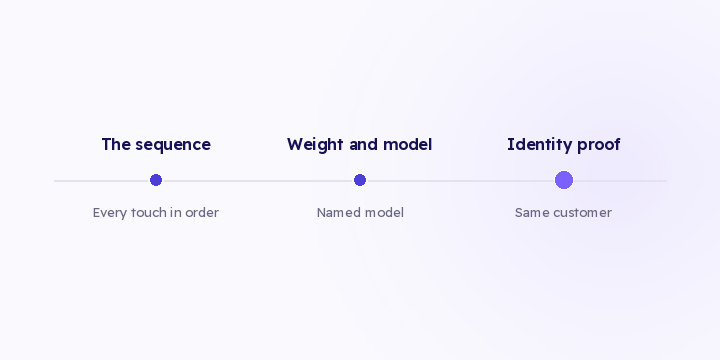
An 890 SAR order credited to a channel you didn't spend on this month. If you can't explain why, that number dies and takes every other figure from the same source with it.
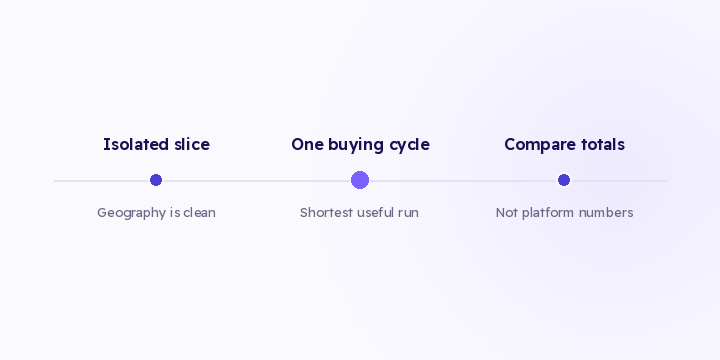
No attribution model answers this question. The only method is a holdout, and it costs real money. Here's how to design one and which channel deserves it.