

Attribution
How to settle an attribution argument by opening one order
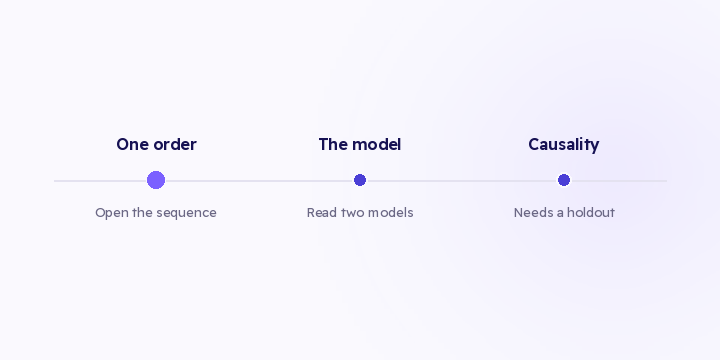
Most arguments about channel performance aren't arguments about data. Identify the type first, because only one of the three is settled by opening a record.
2 min read
Every attribution model is an opinion written as an equation. The useful question isn't which one is most accurate, it's which assumption matches how your customers actually buy.
Here's what each model believes, when to use it, and the setting that matters more than all of them.
| Model | Belief | Best for judging |
|---|---|---|
| Last touch | The final push is everything | Retargeting, branded search, closing efficiency |
| First touch | Discovery is everything | Awareness, creator content, new-customer acquisition |
| Linear | Every step contributed equally | Short cycles, small baskets, when you want to assume least |
| Position-based | Start and end beat the middle, usually 40% each | Balanced funnels where discovery is genuinely hard |
| J-shaped | The close matters most, the opening still counts | Cheap discovery, expensive closing |
| Time decay | Recent touches outweigh distant ones | Long cycles, high-ticket products |
Last touch is the default in most tools, and the most misleading one if you read it alone.
The final step before a purchase is usually cheap: retargeting someone who already knows you, or a branded search from a customer who was coming anyway. So the channels nearest the conversion look like heroes, and everything at the top of the funnel reads as waste.
Cut the top and the numbers genuinely improve for about two weeks. Then the retargeting pool stops refilling and everything below it thins out, weeks after the decision, which is why nobody connects the two.
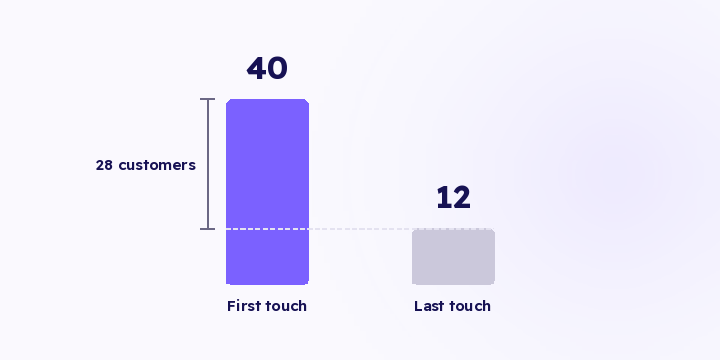
A Snapchat campaign. Spend 6,000 SAR, average order value 400 SAR.
Same period, same orders, same money. The difference is 28 customers who came in through Snapchat and bought later, after a branded search or a direct visit.
On last touch you switch the campaign off. On first touch you scale it. Neither number is wrong, they answer different questions.
Hypothetical figures, for illustration.
Before arguing about models, check your attribution window, the longest gap between first touch and purchase where credit still counts.
With a 7-day window, a customer who takes 40 days to decide has their opening touch erased. Awareness campaigns, creator links and slow-working content all read as zero. Not because they didn't work, but because the tool can't see far enough back.
The error is systematic rather than random: fast campaigns take the credit, slow ones get cut first. Six months later the whole account is retargeting.
Flowfy runs a 90-day window, so those distant touches are in the calculation before any model debate starts. A model can only divide what it can see.
Start from the question, not the screen:
Then judge each campaign on the model that matches its role in the funnel, rather than running one model across everything.
Which model is most accurate? None of them. Accuracy is the wrong frame, because they're different lenses on the same events. The useful test is which one gives you a clearer spending decision this quarter.
Should I just use data-driven attribution? Algorithmic models need volume before their output means anything, typically hundreds of conversions and thousands of paths inside the window. Below that, reading the full path as it happened is more honest than a model fitting noise.
Does changing the model change my revenue? No. It changes who gets credit for revenue that already happened, and the order count doesn't move.
Check your attribution window first. If it's shorter than your buying cycle, fix that before you open the model discussion, because no model can recover touches that were discarded before they reached it.
Most arguments about channel performance aren't arguments about data. Identify the type first, because only one of the three is settled by opening a record.
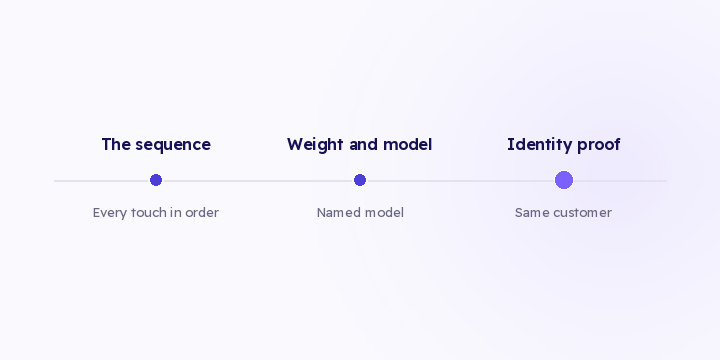
An 890 SAR order credited to a channel you didn't spend on this month. If you can't explain why, that number dies and takes every other figure from the same source with it.
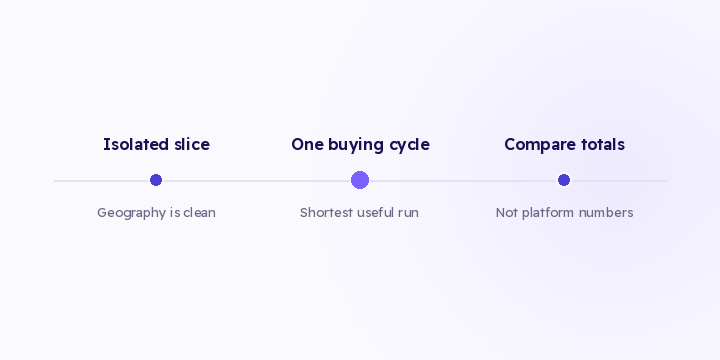
No attribution model answers this question. The only method is a holdout, and it costs real money. Here's how to design one and which channel deserves it.